Dimensionality Reduction
What is Dimensionality Reduction
Dimensionality reduction reduces the number of input features while preserving as much meaningful information as possible.
There are two main approaches:
Feature Selection
= selects a subset of the original features based on their importance, relevance, or redundancy
Methods
- Forward Selection: Add features one by one based on performance improvement
- Backward Elimination: Start with all features and remove the least useful
- Bidirectional Elimination: Combines forward selection and backward elimination.
- Score Comparison: Use statistical or model-based scores (e.g., ANOVA F-test, mutual information).
Feature Extraction
= transforms original features into a lower-dimensional space using mathematical techniques
Methods
- Principal Component Analysis (PCA)
- linear technique that finds orthogonal components maximizing variance in the data
- Linear Discriminant Analysis (LDA)
- supervised method that projects data to maximize class separability
- Quadratic Discriminant Analysis (QDA)
- similar to LDA but assumes each class has its own covariance matrix, allowing quadratic decision boundaries
- Kernel PCA
- extends PCA using kernel methods to capture non-linear patterns
- t-Distributed Stochastic Neighbor Embedding (t-SNE)
- non-linear technique for visualizing high-dimensional data in 2D/3D, optimized for preserving local structure
- Uniform Manifold Approximation and Projection (UMAP)
- fast and scalable non-linear dimensionality reduction method, preserves both global and local structure
- similar to t-SNE but faster and often better at retaining overall shape
- Autoencoders
- neural network-based models that learn a compressed latent representation through reconstruction
PCA vs. LDA
Comparison
- PCA capture the variability; LDA class separation
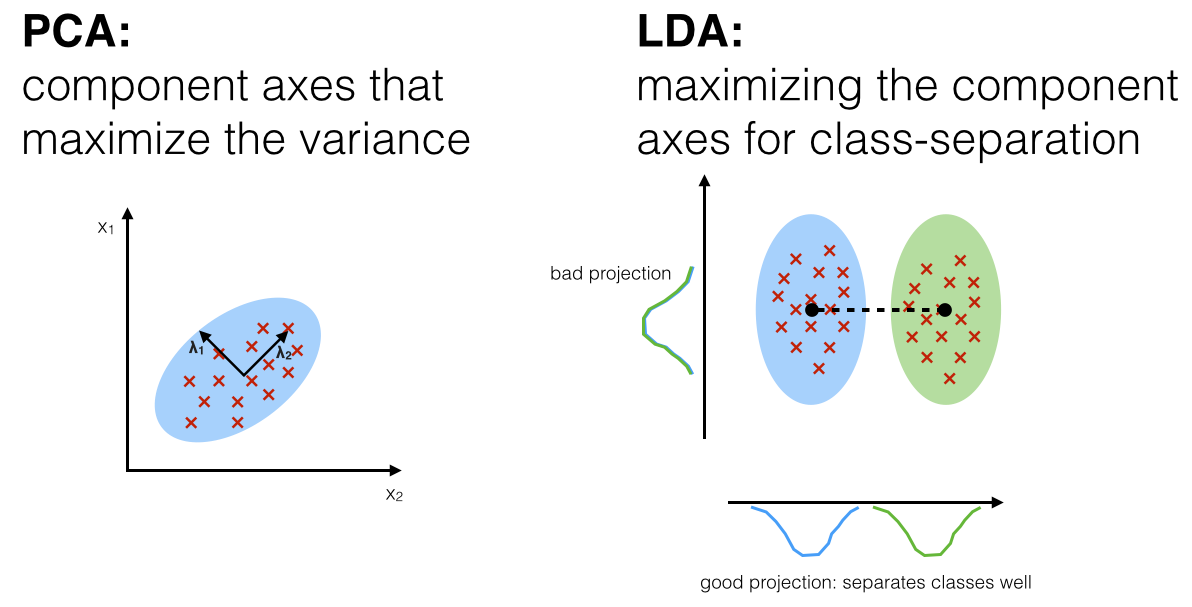
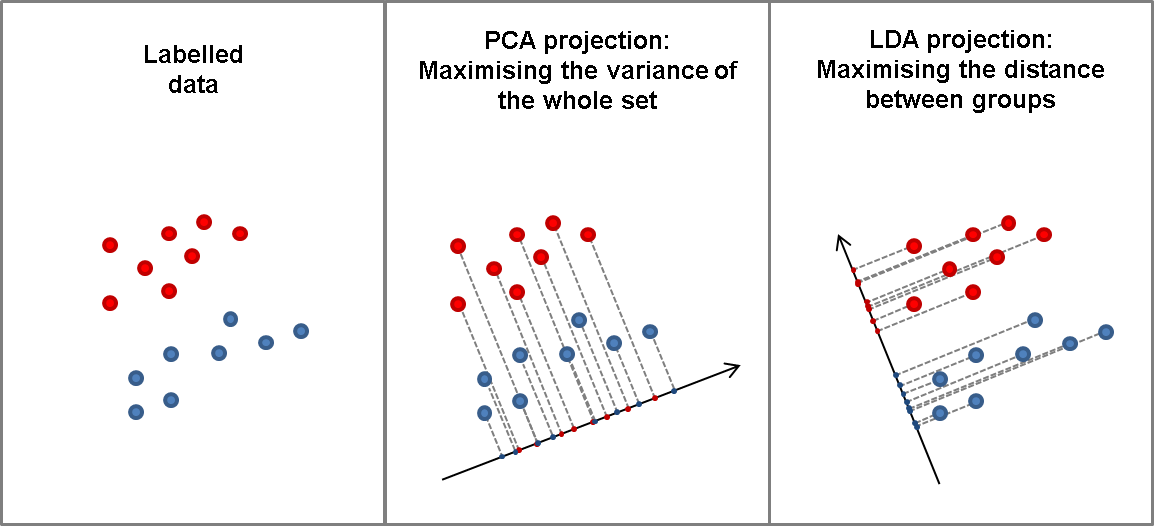
- PCA is unsupervised; LDA is supervised (because of the relation to the dependent variable)
How LDA works exactly
- it creates new axes to maximize the class-separation, step by step (2-class example):
- maximize the distance between class means
and - minimize the variation (which LDA calls "scatter") within each class
and - compute
(= ) and LDA should maximize it - if more than 2 classes, e.g. there are 3 classes, the value to be maximized will be
- maximize the distance between class means
t-Distributed Stochastic Neighbor Embedding (t-SNE)
-
t-SNE takes high-dimensional data and reduces it to a low-dimensional graph (2-D typically)
-
- it calculates a similarity measure based on the distance between points instead of trying to maximize variance.
-
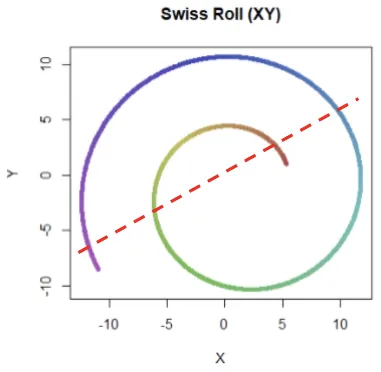
Unlike PCA (which is linear), t-SNE can reduce dimensions with non-linear relationships (such as “Swiss Roll” non-linear distribution)